
In our last article, we discussed how, in On the Brink, we maintain and elevate our aerobic capacity. The area I did not get into was anaerobic-threshold training.
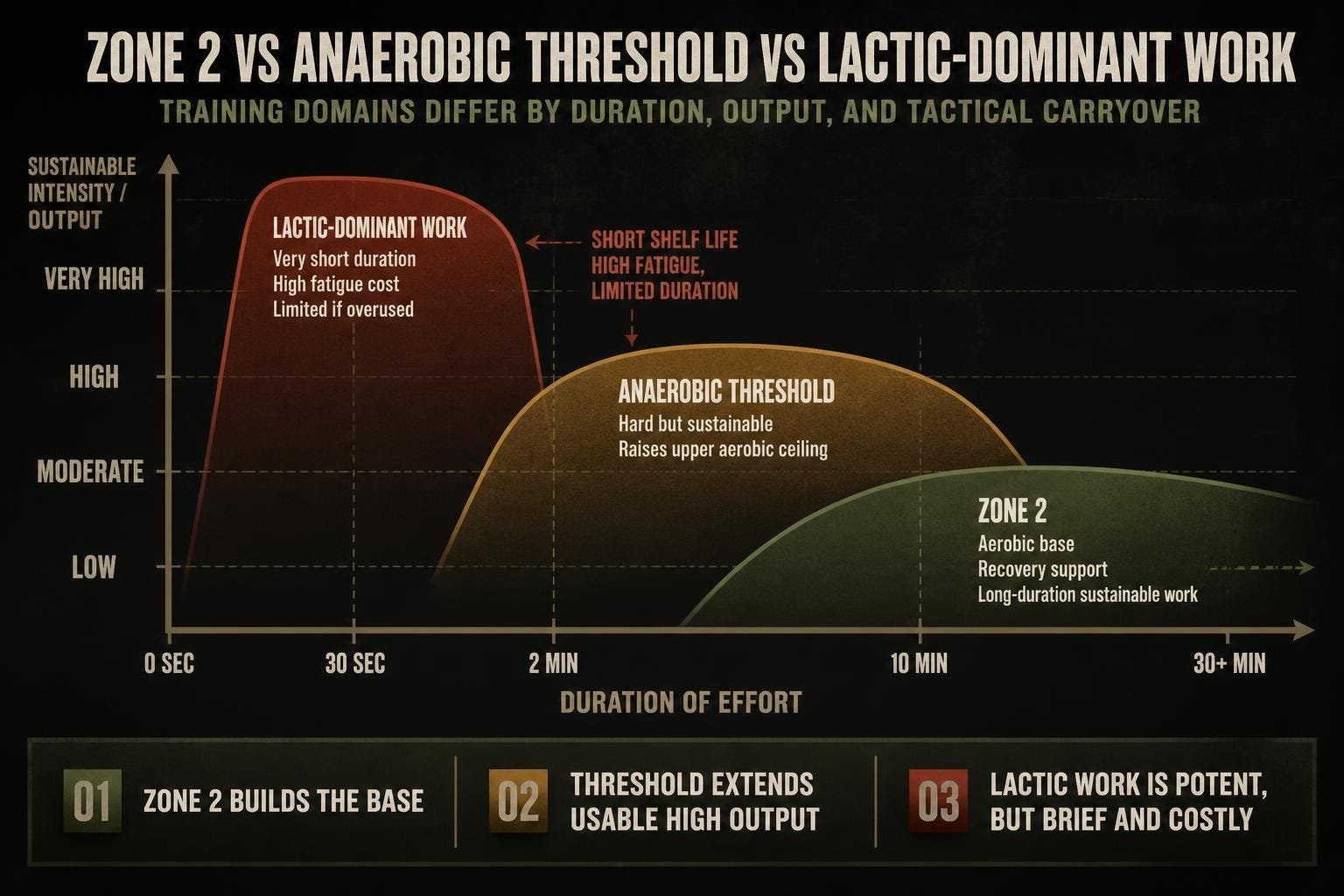
Anaerobic-threshold training is performed near the point where the contribution of the anaerobic system begins to increase substantially. It should be noted that both systems are always working; it is simply a matter of which one is more dominant. This is a hard but sustainable pace.
The foot pursuit, the structure fire, the active shooter, the fight—anything that goes longer than a couple of minutes and is beyond a conversational pace—should be performed near your threshold.
Those who do not train this quality will tip right over into their anaerobic system. They redline. They panic. They gas out. You have all heard their voices on the radio.
The good news is that, combined with solid field training and experience, this quality is trainable.
Chart below. It is not all-inclusive; it is intended only to provide a visual reference for the reader. These time frames are not set in stone, as no individual is the same:
The Basics
Our aerobic system relies on oxygen and can provide energy for much longer periods of time. Our anaerobic system derives energy through pathways that do not rely primarily on oxygen.
In the simplest terms, although both systems are working simultaneously, the longer you can rely on your aerobic system for physical performance, the longer you can maintain performance and display strength. You are also less likely to panic and gas out.
Raise Your Threshold
Anaerobic threshold, as stated before, is the point at which you are working near the upper limit of what you can sustain aerobically. This point is usually tied to a heart rate and the point at which your body is no longer clearing lactate as effectively. The most accurate way to determine it is in a lab.
A practical way to estimate it is to pick a distance on a track or complete a timed trial lasting anywhere from 10–15 minutes, or even as long as 30 minutes. Push yourself at a hard but sustainable pace for that time while wearing a heart-rate monitor, and record your average heart rate. This will get you reasonably close for training this quality.
You can also do this with complexes, sled work, a bike, or even a combination of modalities. To track progress, I recommend either using the same method or modality for a few weeks, or keeping multiple records from different activities in which you maintain your threshold. This allows you to go back and see whether you can complete more work in the same period or cover more ground.
Training to raise our anaerobic threshold requires using that average heart rate as a rough reference. When this is the training goal, try to keep yourself within approximately ±5 beats per minute of that number.
Let’s say you ran for 15 minutes and your heart rate averaged around 170 bpm. That means that when you train this quality, you should get yourself to around 165 bpm and avoid letting it rise above 175 bpm.
I want to be clear that this is an estimate. On certain days, this range could be a little higher or lower depending on your fatigue and various other factors. You will need to use this heart-rate range in combination with your pace, how you are moving, and whether you are able to maintain your output for a prescribed time or rep range.
Day 6 From On the Brink
We are going to reference Day 6 of the program below:
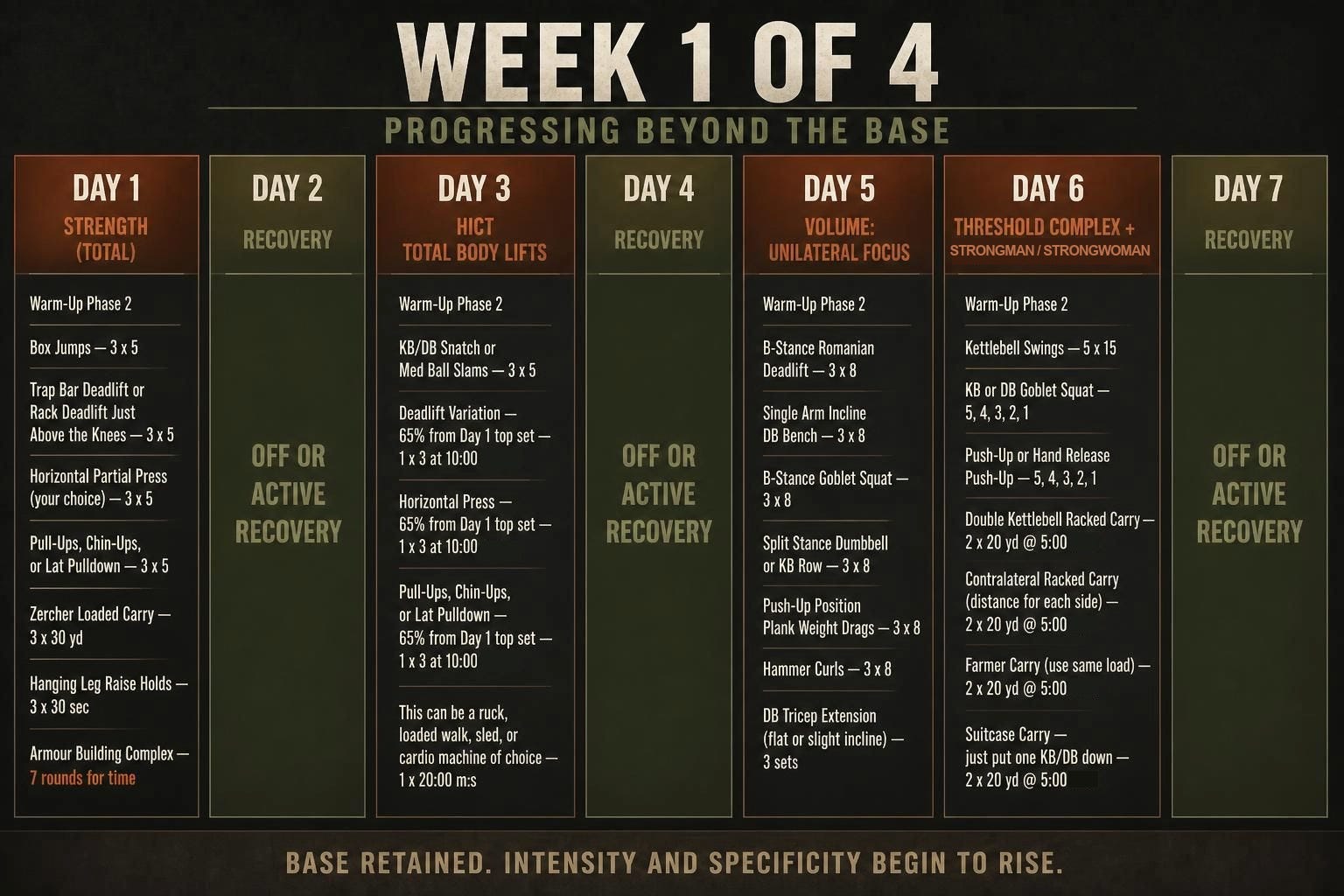
Day 6: Threshold
We are going to use old-school strength coach Dan John’s Human Burpee as the modality for training this quality. The idea is to move at a pace that gets your heart rate up to your anaerobic threshold.
Complete five rounds:
-
Kettlebell swings × 15
-
Kettlebell goblet squats × 5
-
Push-ups or hand-release push-ups × 5
Each round, keep the swings the same, but reduce the other movements by one rep. The second round is 15 swings, four squats, and four push-ups. Continue until the final round, which is 15 swings, one squat, and one push-up.
Record your time.
Then complete 2–3 minutes of active rest. Walk around, pedal a bike—whatever works. Just do something easy.
We follow the threshold work with a medley of carries. Keep moving for five minutes, and let your heart rate get up to approximately 150–155 bpm. This is higher-end aerobic work, and you will still be somewhat fatigued. If your heart rate starts climbing, slow down or stop for a bit.
This provides a little more loaded aerobic work while also teaching you how to calm down and manage fatigue.
Over the following weeks, we will increase the reps on the push-ups and squats while keeping the swings at 15. We will also increase the duration of the carry medley to a total of 15 minutes.
Although I keep saying this is not a true redline, this is certainly a challenging session.
Why
For all the reasons described above, but also because this is loaded conditioning. The nature of your job requires you to carry loads and move while under load. Loaded complexes and carries are a great way to train this without beating yourself up with a lot of mileage or other modalities, assuming your form solid on all of the movements.
There is nothing wrong with running, and we will work more of it into our next phase. For this month, however, I like to focus on these tools. I also think most people will end up doing some form of long, slow-distance running on their off days, so the average trainee will still get some mileage in if they chose to.
Closing
This is a challenging session. When many people hear or read “slow down if your heart rate gets above a certain zone,” they interpret it as taking it easy on themselves. Anyone who has done a session like this knows that is not the case.
Could you move at an even harder pace, to the point where you can barely keep functioning? Sure. But I would argue that is actually easier conceptually.
Instead, I want you to find the hardest pace you can manage for a given time period or rep range. Maintain the appropriate force, speed, power, or other relevant quality, and keep moving while staying below the point at which your physiology will eventually cut you off- because it will.
When you do this training, you will learn the pace at which you can move and still function. You will learn where you may have limits and where you can improve.
More importantly, once you learn what that feels like, you will eventually raise that point—your threshold—through proper training. You will also be better able to apply that understanding when you are actually on the street.
Next week, we’ll discuss the strength component of this program and how we are able to nest it into the overall program.
Questions?
Reach out.