
Training hard is not enough if your programming is not taking you where you need to go.
Direction
I remember that in my first or second week as a brand-new cop, I was driving around with my Field Training Officer (FTO). He instructed me, in a relatively busy area, to pull over on the side of the road and stop the vehicle. I thought I had done something wrong, but then he simply asked me something to the effect of:
“Where are we?”
Silence.
“What street are we on?”
I saw where he was going with this.
“What are the cross streets?”
“I have no idea.”
“Always know where you are. What if something happened right now? Could you tell anybody where you were?”
Point taken.
This is somewhat of a cliché story that any decent FTO will use with a new recruit. Considering this was almost 20 years ago and I still remember it, it obviously had an impact on me.
Always know your location.
This concept should also extend to your training, particularly your strength and conditioning to support your performance as a first responder or tactical professional. All too often, I talk with these extremely motivated individuals who are looking for guidance with their programming. They list off a bunch of goals, but then follow programs—or just do random workouts—that don’t actually lead to their stated outcomes. They’re working hard, but they don’t necessarily know where they’re going or if they’re even covering ground.
Nothing is truly measured other than perceived effort. As somebody who trained this way for years, I understand the drive. You want to feel like you worked hard, and you almost feel guilty if you’re not exhausted or taking every set to failure during your exercise session.
The problem is that, if you’re honest, you usually look back a few weeks later and realize your lifts haven’t moved much, if at all. You’re not running faster or doing more work in a shorter amount of time, and you’re probably trying to figure out why you developed tendinitis somewhere.
But for some reason, you did it again and again.
Once you start measuring where you’re at and where you’re going—if you know where you are—everything changes.
The past few articles in this series have covered eight weeks of programming with targeted goals that, if you’re tracking your training, you should absolutely see improvement in. Now, because of the time you put in building your strength, aerobic base, and threshold conditioning, we finally make it to this final phase. This phase is designed to push your conditioning while maintaining your strength and aerobic base.
Like in our last series, we will go through each training goal in each of these articles.
Strength Training During the “Into the Frontier” Phase
Please reference Training Week 1 below. Days 1 and 5 will be true strength-training days during this phase. Yes, just two strength days.
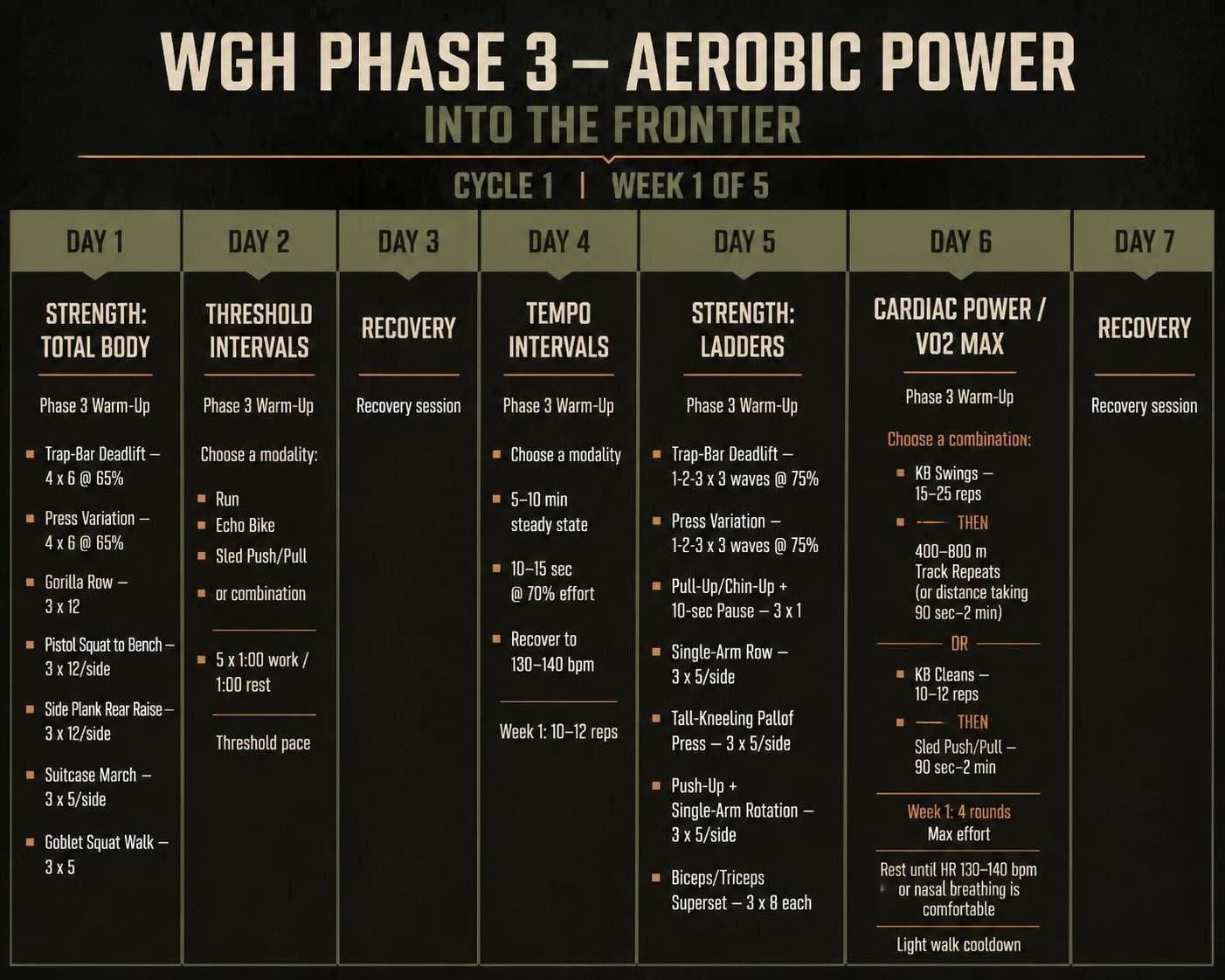
For the people who are already thinking that two strength-training days are not enough, you need to look at the big picture of the program. This program is designed with the idea that police officers and other first responders not only work demanding schedules, but should also be doing other forms of training, like BJJ and boxing (in the conditioning article we will talk where this work can fit).
Our goals for this phase are to slightly increase or maintain strength while pushing the envelope on our conditioning. These two days—when completed with intent and proper intensity—are more than enough to accomplish that.
This also leaves room in the tank for recovery, performance on the job, and the other training I just discussed.
Day 1- Total Body Strength
These weights will get heavier as the month progresses, but the idea here is that, regardless of the load, you need to move that weight with intent. This is crucial.
Sixty-five percent is a relatively light load. Depending on your experience, the exercise, and how strong you are, you could probably perform significantly more than six reps with this weight. That is not the point of these sets. The goal is to perform six high-quality reps with speed and control while avoiding unnecessary fatigue.
Get your abs tight, squeeze the bar or implement, and lift it powerfully, with some speed, on every rep. This isn’t bodybuilding. Think of it as training for power or speed-strength. The intent should be explosive.
If the bar speed or quality of movement noticeably slows, the load is too heavy for the goal of the set, or you need more rest.
You would perform your trap-bar deadlifts or other compound lower-body lift, rest for about 60 to 90 seconds depending on your fitness level, and then do the same with your press variation. Perform four sets of six for each movement.
This is more challenging than it sounds when it is done correctly. If you need additional rest to maintain bar speed, force production, or technique, take it. The goal is high-quality work, not short rest periods for the sake of feeling tired. You’ll certainly feel some fatigue, but you shouldn’t be totally destroyed. If you’re fit enough to keep the density high, and the bar speed is still fast, feel free to move through this work quick. But just remember the main goal- power.
After that, you move to the accessory work, which can be completed in circuits depending on how much time you have. Usually, doing the first three exercises as a circuit works, and then doing the last two exercises as a superset is time-efficient as well.
I wouldn’t rush through it too quickly, but if you rest about a minute between movements, you’ll be giving yourself two to three minutes of active rest between each separate exercise.
If you’re really starting to grind and your form is suffering, stop for a minute to ensure your movement quality remains high, but it is certainly OK as we get towards the end of the session to get a bit more “traditionally” fatigued.
Day 5: Strength Ladders
Strength ladders are an awesome way to get in high-quality reps with heavier weight. You can perform the main compound movements like you did on Day 1, or you can do these as more traditional ladders, where you stick with the main movements until the ladder is complete.
The way this can look is that you warm up to a load of approximately 75% of your one-rep max. Again, this depends on your strength level and experience on how many reps you can get with 75% of your max. Regardless, in week one this should be a challenging but manageable weight that is right around a 6-8 rep maximum. Since the most reps you’ll do in a ladder is 3 reps, the load should allow you to perform every rep with solid technique and consistent speed.
Perform one rep on the deadlift.
Take a good breath, walk over to the bench or whatever press variation you’re doing, get tight, and perform:
One rep on the press.
Take a breath and walk back over to the deadlift.
Two reps. Take two breaths.
Walk over to the press and perform two reps. Take two breaths.
Do the same for three reps.
You have now completed one wave. Rest for two minutes, then repeat the entire ladder for a total of three waves.
The exact loading and rest may need to be adjusted slightly based on the athlete and the exercises being used. If the third wave turns into a grind or technique begins to break down, reduce the load or stop the ladder rather than forcing low-quality reps.
What you’re going to find as you do these, in the second and third waves, the singles and doubles are going to feel almost lighter. Repeated exposure to the movements can improve coordination, technical efficiency, and force production without requiring repeated near-maximal efforts.
What you’re doing is building volume with moderate-to-heavy loads while allowing your nervous system and movement patterns to become more efficient. As you get better at the movement and really put some drive into it, you can produce high-quality work without causing excessive fatigue.
Then you follow up with accessory work. On this day, it is a little heavier with lower volume, but it can also be performed as a circuit.
This is more of a dedicated heavy-strength day. The weights will get heavier later in the cycle, and this is how we are going to get stronger while we hit those other conditioning days hard.
Closing
Much like the importance of knowing where you are on the street, your programming is no different. Yes, for this phase, you’re doing true, heavy—or at least heavier—strength training a couple of times per week. Hearing that alone doesn’t sound right to a lot of hard chargers. But when you zoom out and look at the totality of the program, it actually makes a ton of sense.
The amazing thing is that we leave the option open at the end of these four weeks to build to a heavy triple. Some people may hit personal records—or rep records—on their lifts during this phase despite the heavy conditioning- because we plan the training month out in a manner that allows for hard work and recovery.
The past 8 weeks and then leading into this training month will not only build strength, but also technique, work capacity, fatigue management, and the ability to produce force without wasting energy. We not only trained hard; we trained smart.
In the next article, we’ll discuss the conditioning in this program. You’ll learn how it complements your strength work while still leaving room for self-defense training.
Questions? Reach out.