

Conditioning/Energy System Development
Key Takeaway
For Tactical Populations and First Responders it is important to understand that the strength and conditioning program you follow needs to fit where you are at in your life and career. Busy schedules, life stressors, shift work, and unpredictable hours make training quite challenging for these professions. For long term progress you will need to remain flexible with your training schedule and understand when it is time to push the intensity or dial it back.
This week I’ll show you how to design your conditioning/work capacity sessions,
Conditioning Sessions- Why
In the We Go Home Human Performance Program we put a premium on conditioning. You’re not much good responding to an active shooter if you can’t briskly walk up a flight of stairs without being out of breath. The guy running from your traffic stop doesn’t care what your bench is if he thinks he can outrun you and/or tire you out before assaulting you. The fire doesn’t care how much you can squat…OK I think I made my point.
Don’t get me wrong. Strength is important, but it has to be balanced with conditioning so you can also do everything else that is required in these professions. We will use the same training week from the last article to discuss this.
Example Week
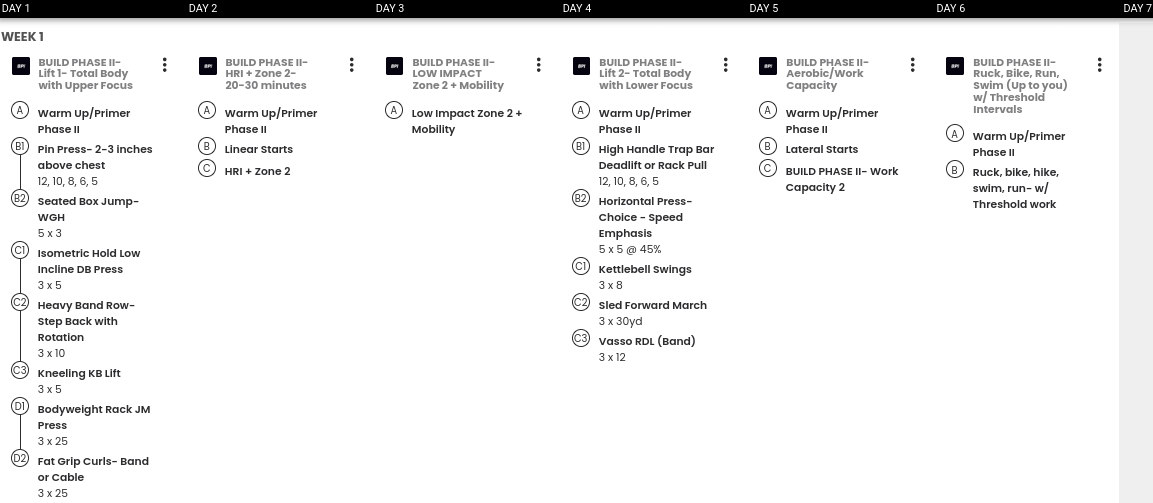
In this phase we are focusing on strength and muscle development and foundational work capacity. Although this is technically the second phase of our yearly cycle, the conditioning during this phase is still going to be aerobic focused.
For the training week above we technically have built in 4 conditioning sessions.
Day 2
This is a movement and then sprint focused session. The key here is the High Resistance Intervals (HRIs) are basically “sprint” intervals that last about 10 seconds and then followed by full recovery. I also put “sprints” in quotations because not everyone does traditional sprints here.
Instead I prefer them to run up a hill, push/pull a sled, ECHO bike, or just something that adds resistance. This slows the trainee down just a bit which ideally lessons the likelihood of a muscle strain. We then end this session with a little Zone 2 if our Hero has time. If you don’t have the time at the end of the session, you can work the extra work pretty much anywhere in the rest of the training week. Or if you’re feeling run down, during an extra recovery day.
Day 3
Although this is more of a recovery focused day, it is still important to work in low impact Zone 2 during the week. Think of this as slightly labored but “conversationally paced” cardio. This day not only facilities recovery but also creates some incredible adaptations in the heart and your peripheral cardiovascular system. For more information on that see this article.
Day 5
Another movement day that focuses on lateral starts, and then we do a 30 Minute (in Week 1) work capacity circuit consisting of:
A1) Box Jumps x 5 (Not too high, and step off the box)
A2) Plyo Push Up x 5
A3) Landmine Rotation x 5 ea way
A4) Standing Ab work x 5-10 Reps
A5) Inverted Rows x 5
You can do this circuit in two ways. You can run through the entire thing at a challenging pace, rest until your heart rate comes down to about 130 bpm, and then repeat.
Or
You can keep doing each of these movements at pace that lets you repeat the movements for the entire thirty minutes. Only slow down or rest for a bit if your heart rate starts to get up to about 160 bpm. We are pushing your ability to do as much work as possible while staying mostly in your aerobic system.
Day 6
This day you work in longer movements interspersed with threshold intervals. These are sometimes called “Fartlek” intervals. You can mix in various modalities or stick with one each week.
In week 1 you have a 30 minute session that includes 5 sets of 2 minute interval sessions.
The way this could look is you go for a ruck. Walk at a pace that lets your heart rate stay within about 115-150bpm, and then after a few minutes really step it out to get your heart rate up to around 160-170bpm. Hills help if you’re in decent shape. After 2 minutes, slow back down and walk at that slower pace for 2-5 minutes before repeating. This will help raise your anaerobic threshold which means you’ll be able to rely on your aerobic system for longer periods. This means being capable of more work at higher intensities for longer periods, and faster recovery times between higher intensity bouts.
Closing
Remember, this is a snapshot from a yearly cycle of training. We will progress the trainee to more challenging methods and volumes at different times of the year. Regardless, we still structure our week to allow for minimal interference with strength work and other adaptations, and have the built in flexibility that is required for this lifestyles.
Questions? Reach out or comment.