
Note: I am not a doctor, and I am not dispensing medical advice. If you’re going through something like this, talk to your doctor before you do anything you read here. This is just what worked for me and how I have learned to apply these concepts to everyone who still has all the joints they were born with and wants to finish a 20-year career with the same level of fitness—or higher—than they started.
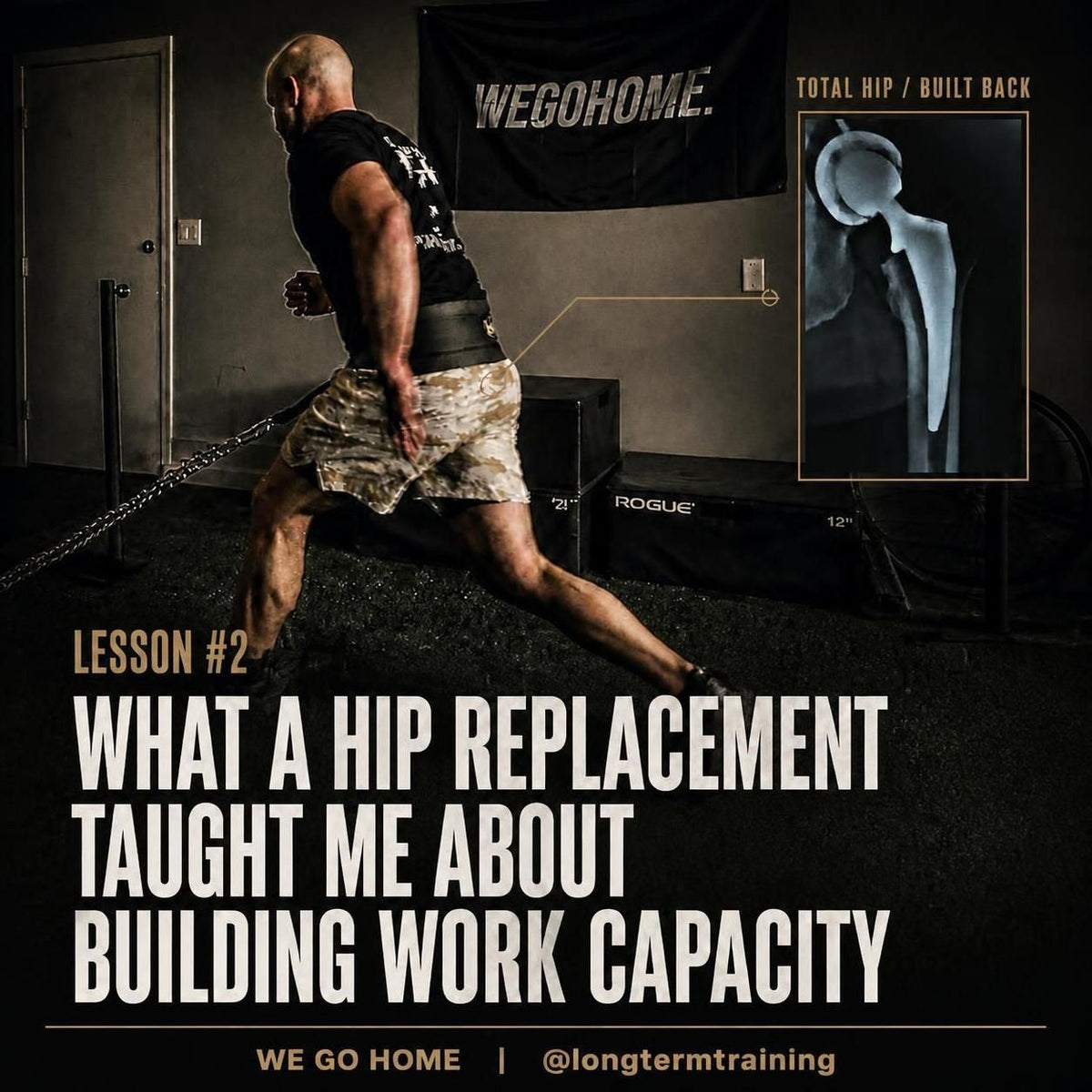
Getting the top of your femur sawed off and replaced with titanium taught me a lot about this topic. The horrific arthritis I had in the joint prior to surgery did as well. The lesson is that running, running with load, and sprinting are true high-impact events for the body.
To provide context, here are some numbers:

These figures describe peak vertical ground-reaction force—the force transmitted between the foot and the ground in a single step, not direct measurements of force on a specific joint. (Udofa et al., 2017)
Our takeaway here is that hard running and sprinting are relatively higher-intensity activities that create a greater recovery debt. This isn’t necessarily a bad thing; it just means these activities need to be managed.
Having these abilities—sprinting and sustained output—I would argue, is foundational for tactical and first responders.
First responders and tactical professionals should weigh their injury history, age, training age, and goals when structuring their training week around sprinting or higher-mileage running.
This also means understanding what other tools are out there when working on your conditioning. There are many ways to get this work in, and running is just one way to do it. Even if you have all your joints still intact, variation can be your friend and provide a way to avoid overuse injuries while still building your conditioning—particularly in your gray-beard years.These figures describe peak vertical ground-reaction force—the force transmitted between the foot and the ground in a single step, not necessarily pure measurements on a joint itself. (Udofa et al., 2017)
Our takeaway here is that hard running and sprinting are relatively higher intensity that will require more of a recovery debt. This isn’t necessarily a bad thing, it is just that these activities need to be managed. Having this ability- sprinting and sustained output- I would argue are foundational qualities for the Tactical or First Responder.
The First Responder and Tactical Profession should weigh their injury history, age, training age, and goals with how they structure their training week when including sprinting or high mileage running.
This also means understanding what other tools are out there when working on your conditioning. There are many ways to get this work in, and running is just one way to do it. Even if you have all your joints still intact, variation can be your friend and provide a way for you to avoid overuse injury while still building your conditioning- particularly in your gray beard years.
Key Concepts From This Series
We’re on #3
-
Start slow, listen to your doctor, and don’t rush to failure.
-
Build work capacity.
-
Find YOUR conditioning modalities.
-
Find YOUR compound lifts.
-
Corrective work and physical therapy can fit well into your warm-up.
-
Total-body training or upper/lower splits usually work best for strength.
-
Focus on the aerobic system first.
-
Add volume before intensity.
-
Track and follow a progression.
-
Measure progress holistically—in weeks, months, and years, not workout to workout.
3. Find YOUR conditioning modalities
After surgery, I realized that as much as I enjoyed a couple of longer, slow runs a week, this activity probably wasn’t going to be my go-to.
As much as I like to trust my surgeon, the reality is nobody really knows how long these implants are going to last. Of course, the more impact you put on them, the more you probably push the materials toward the edges of their capability.
Even if you aren’t post-hip replacement or coming back from some other serious surgery, things tend to change as you get older. All of the mileage you’ve accumulated over the years can impact recovery, and “just going for a run” can sometimes impact the rest of your training.
This is where you might need to figure out other options that work for you without beating up your joints or aggravating that injury you had when you were 27 that is now causing your back to hurt in your 40s.
With that said, I still sprint, run, and ruck. I just do it in conjunction with multiple other activities so I can manage mileage and save it for when it truly counts.
I also use other activities to get myself into certain heart-rate zones. They won’t transfer perfectly to running, but they can still build a gas tank just the same. You just need to keep in mind what you’re trying to train.
The more specific the test, mission, or event, the more that exact modality should remain in the plan.
A strength coach I respect, Dan John, sums this up perfectly:
“Specificity works, but at a price.”
My Top Options
-
Sled
-
Rogue Echo Bike
-
Resisted sprints
-
Heavy bag
-
Kettlebell complexes/circuits
-
Strength circuits: barbell or landmine
-
Rucking or weight-vest walking
-
Med-ball work
-
Club or mace exercises
-
A combination of everything above
Tons of options, and the best part is you can set this up in almost any way to fit your goals by manipulating work/rest periods and heart-rate zones.
For this article, I’ll focus on the aerobic system, where probably 80% of your training should be.
Targets
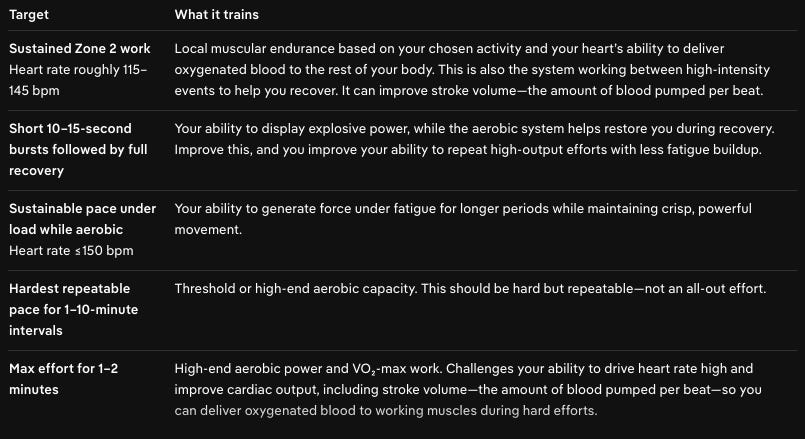
For me, the way this looks depends on what I am training and when. I can combine any of the above methods in almost any way I want, and as long as I abide by the above parameters, I can train a specific quality of the aerobic system.
If I want to get a little better at something, like boxing, I box more. If I want to improve some facet of running, I run a little more.
If I have no specific goal, I keep things as general as possible on my work-capacity days and use lots of variation. I believe that variation is how I avoid less overuse injuries than I have had in the past.
Examples:
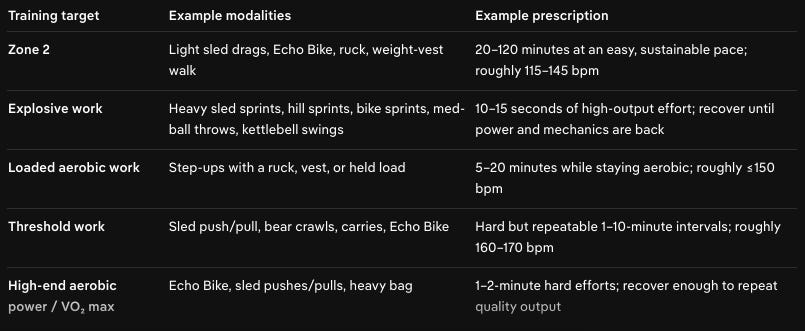
Zone 2
Maintain a heart rate of around 115–145 bpm and do light sled pulls: forward, backward, laterally, while lunging, while overstriding and pulling with your heel, or any other method you can think of.
You can also hop on a bike, ruck, or weight-vest walk. Keep a sustained pace. Depending on the goal, this can be anywhere from 20 minutes to two hours.
The exact heart-rate number is individual. Use the number as a starting point, but pair it with an easy, sustainable effort and the ability to breathe and talk without fighting for air.
Explosive Work
Perform heavy sled sprints with max effort for 10–15 seconds. Repeat when your breathing has settled and you can hit the next rep with the same intent, mechanics, and power.
Heart rate can be one reference point, but it should not be the only one.
If the load is moderate and output remains high, these can sometimes be done every minute on the minute. If speed, power, or mechanics begin to drop, extend the rest.
Bike sprints, hill sprints, or kettlebell swings for 8–10 reps a round work here as well. Med-ball throws work here too.
Loaded Aerobic Work
Step-ups: Wear your ruck or weight vest, or hold weight. Perform 5–20-minute sets while your heart rate stays around 150 bpm.
Threshold Circuit
Heart rate roughly 160–170 bpm
-
Push sled: 40 feet
-
Pull sled: 40 feet
-
Bear crawl: 40 feet
-
Kettlebell racked carry: 40 feet
-
Echo Bike: 2–5 minutes
This circuit can be done continuously for several minutes, or you can do a couple of rounds, perform Zone 2 work for five minutes or so as active rest, and then go again.
This is a practical threshold-style circuit, not a laboratory-perfect threshold test. Keep the loading light enough that movement stays clean and the pace stays sustainable.
High-End Aerobic Power / VO₂-Max Work
Max effort for 1–2 minutes, followed by enough recovery to repeat the effort with quality:
-
Echo Bike
-
Sled pushes or pulls
-
Heavy bag
For high-end aerobic power, you can also combine a kettlebell or club movement after crushing yourself on one of the implements above.
How This Applies to Non-Cyborgs and Closing
If running is not an issue for you, you enjoy it, or you have a run-heavy test or event coming up, then of course, do more running. There is nothing inherently wrong with it.
I think most people would benefit from not stacking high-volume running days back to back. This is where proper program design comes in, and why I usually put sprint work early in the week, threshold work in the middle, and higher-volume conditioning later in the week.
Regardless, you should be doing some form of conditioning designed to target the qualities I listed above.
Use lower-impact conditioning to build and maintain your engine, but do not confuse that with eliminating task-specific work. If your job, selection, assessment, or event requires running, rucking, stairs, or load carriage, those still need to show up in training. The point is to earn the right to do more of that work—not to replace it entirely.
I hope I provided some other options you haven’t thought of that can plug gaps in your training when you want to dial back running mileage and bring in new movements to keep training novel, fun, and engaging.
Simmons, L. (2015). Special strength development for all sports. Westside Barbell.
Udofa, A., Ryan, L., Clark, K., & Weyand, P. (2017). Ground reaction forces during competitive track events: A motion based assessment method. ISBS Proceedings Archive, 35(1), Article 120.