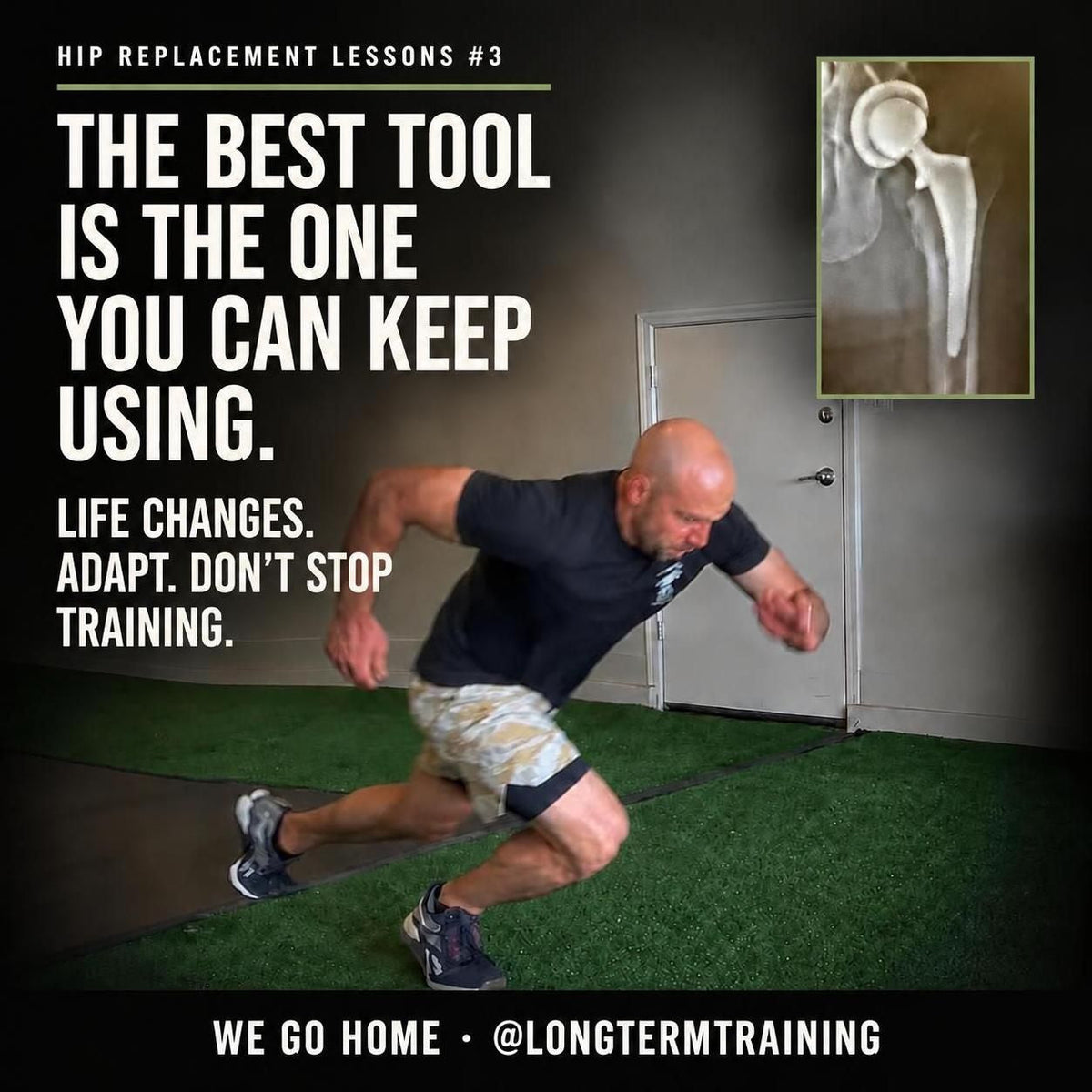

Lessons from recovery for tactical athletes who want to train hard, recover well, and last the full career.
Note: I am not a doctor, and I am not dispensing medical advice. If you’re going through something like this, talk to your doctor before you do anything you read here. This is just what worked for me and how I have learned to apply these concepts to everyone who still has all the joints they were born with and wants to finish a 20-year career with the same level of fitness—or higher—than they started.
We are continuing with my series on what I’ve learned after my recovery from a total hip replacement. That recovery helped shape the fundamentals of training that informed my training philosophy and has kept me operating at a relatively high level despite joining the bionic world in my mid-thirties.
These are the “rules” I have learned over the years that lead to longevity in the tactical realm, and a training methodology that doesn’t fight you but instead elevates you for the 20-year career.
Quick Review of Key Concepts
-
Start slow, listen to your doctor, and don’t rush to failure.
-
Build work capacity.
-
Find YOUR conditioning modalities.
-
Find YOUR compound lifts.
-
Corrective work and physical therapy can fit well into your warm-up.
-
Total-body training or upper/lower splits usually work best for strength.
-
Focus on the aerobic system first.
-
Add volume before intensity.
-
Track and follow a progression.
-
Measure progress holistically—in weeks, months, and years, not workout to workout.
2. Build Work Capacity
My definition of work capacity is the total amount of work you can perform and recover from—your base fitness.
If your goal is to get stronger or run faster and your training is outpacing your ability to adapt, you’ll just keep digging a hole that you can’t get out of. That means no matter how hard you feel like you’re working, you’ll end up hitting a wall and, at best, your training will stagnate. Then the tendonitis starts to creep in, and at worst, you get legitimately injured.
This concept is somewhat in line with my first point about “starting slow” and not “rushing to failure,” but in practicality, it means a bit more than that. For me, it meant having a plan to build tolerance.
If I am honest, due to my lack of patience post-op, this probably took longer than it should have. This doesn’t mean I didn’t start building my strength and conditioning back faster than most, but it unfortunately meant that I was more apt to get muscle strains and overuse injuries because I tried to jump right back into what I was previously doing.
My path was:
-
Basic range of motion
-
Walking/bike
-
Upper-body lifting
-
Light lower-body work
-
More comprehensive programming
I’ll tell you right now: I rushed through all of this. I lifted too heavy on my upper body, which led to some chronic overuse injuries that took time to heal because I ignored the fact that tendons and ligaments require both load and time to adapt. Although I had some training under my belt, whether or not I wanted to believe it, I had to take a few steps back before I could move forward.
If I had kept everything in moderate rep ranges, I bet I would have better managed fatigue and helped some of the other intangible things that are hard to quantify when healing from such a violent surgery.
What you can truly recover from is paramount in a situation like this, and I would argue it is no different for the average trainee who still has all their own joints.
How This Applies to Non-Cyborgs
What is the takeaway for future police officers, firefighters, or various tactical professionals?
You need to build your work capacity over time. A great way to do this at first is to use sessions where you gradually turn up the volume or density of the work you’re doing in a given session.
Completing sessions like this grows your gas tank in conjunction with your lifting sessions, creating a big base of fitness that your body can use. This is not always a linear process. Sometimes you need to increase the amount of work you’re doing until you hit the top end of your capacity, then dial it back for a bit as you get used to it.
Below is an easy way to do this and one we have used in our We Go Home Human Performance Program.
Simple Work Capacity Session
Keep this under 30 minutes, or even closer to 20 minutes if you’re very sore. As you adapt, it’ll get easier.
Choose a low-impact cardio activity, such as a spin bike, ECHO Bike, VersaClimber, or dragging a light sled. Grab a light kettlebell, dumbbell, or sandbag.
Stay at a conversational pace—often around a heart rate of 120–140 bpm for many people.
At each interval, pause to complete:
-
5 swings
-
1 clean (or row)
-
1 press
-
1 squat
Complex above is to be repeated:
Week 1: Every 5 minutes
Week 2: Every 4 minutes
Week 3: Every 3 minutes
Week 4: Every 2 minutes
So in Week 1, you hop on the ECHO Bike for 5 minutes at an easy pace, then hop off and complete the KB complex above. Then hop back on for 5 minutes before repeating the complex. You’ll do this for 20–30 minutes, which will end up being 4–6 rounds. By Week 4, you’ll do this every 2 minutes, which will equal 10–15 rounds.
This is an easy way, over the course of 4 weeks, to slowly turn the dial up without digging yourself into such a debt that the rest of your sessions start to suffer. The kettlebell or weight you use should be light, the cardio modality low impact, and you should listen to your body. If you’re exceptionally sore, your sleep has suffered, or you just don’t feel recovered, keep this session around 20 minutes regardless of how many rounds you get in.
The key is letting the amount of work you do wave up and down, but if you look over the course of 4 weeks, you overall did more work per session over time.
As these individual sessions improve, the next step is adding another session that is similar to this on a different training day. As that gets easier, slowly increase the amount of work you do on that day as well. At that point—months down the road—time can be added to each session, slightly heavier weight can be used, or a myriad of other variables can be tweaked.
You’ll notice as these sessions improve, your main workouts will start to feel easier, you’ll recover faster, and you’ll open more doors for using harder training methods.
Closing
This is the path to long-term, sustainable progress in this professional realm. It takes patience to come back from surgery. It should also take patience to understand that if you’re building yourself into a unit, it usually doesn’t happen by just jumping blindly into whatever is trendy.
It is about viewing yourself as a machine that is going to require the parts, fuel, and maintenance to survive the rigors of these professions. Skimping on this will cap your potential and limit your long-term results.
Simmons, L. (2015). Special strength development for all sports. Westside Barbell.